Have you ever heard an Indian raga? If you did, especially sung professionally, you should have been impressed. Because, indeed, you have never heard anything of the kind.
A group of Russian sahaja yogis who studied in India and made a tour of the cities of the so-called Golden Ring gave a concert in the Folk Theater in the main street of Kostroma, Russia. As three young men began to sing, my neighbour giggled and sat cross-handed. Apparently, he had no habit to hear this kind of music. With their deep, trembling, vibrating, fluid voices the singers touched the very roots of my being. The song seemed to combine both improvisation and a rigid structure. Subtle and delicate at the beginning, it gradually grew intense and emotional. I closed my eyes to this special meditative music and drifted away on the waves of joy in some kind of trance. If you let it go, if you are receptive, you can learn to listen to ragas and enjoy them. But you must be ready to meet them.
A group of Russian sahaja yogis who studied in India and made a tour of the cities of the so-called Golden Ring gave a concert in the Folk Theater in the main street of Kostroma, Russia. As three young men began to sing, my neighbour giggled and sat cross-handed. Apparently, he had no habit to hear this kind of music. With their deep, trembling, vibrating, fluid voices the singers touched the very roots of my being. The song seemed to combine both improvisation and a rigid structure. Subtle and delicate at the beginning, it gradually grew intense and emotional. I closed my eyes to this special meditative music and drifted away on the waves of joy in some kind of trance. If you let it go, if you are receptive, you can learn to listen to ragas and enjoy them. But you must be ready to meet them.
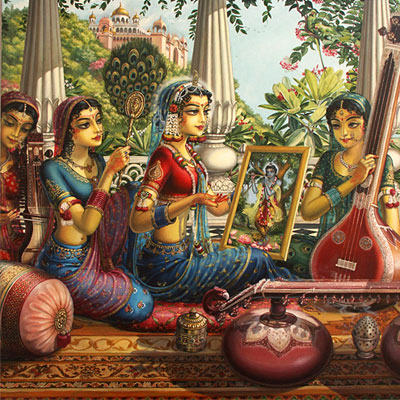 |
| Indian raga performers and their musical instruments |
India's musical tradition is very ancient. It developed in a completely different way than that of Europe. The raga is one of the basic genres. A classical raga consists of two parts: the slow improvised introduction and the main part supported by the clear and intricate pattern of the percussion instruments. At least three participants are engaged. The basics of the sound is the tamboura - a bow instrument playing one single note but rich in timbre. The soloist is a wind instrument, or a violin, or stringed musical instruments played by plucking, or a vocal solo. The third performer, with a range of percussion instruments, joins during the second part. From here, the music becomes most complicated and emotionally tense. The constant rhythm creates a special feeling of time, both strained and able to last eternally.
Different ragas coincide with different periods of the day. It is believed harmful to listen to wrong ragas during a certain daytime. In India, the day is divided in 8 parts, each 3 hours long.
Ra is energy, ga in sanskrit means "the moving one, the one that penetrates everywhere". The raga has all the qualities of ether. Whatever you put in ether, it accepts everything. So the raga is the energy entering ether and touching on your spirit. But, to enjoy a raga, you need to calm down. If you are not well-balanced, you are not able to perceive it.
Consider this: raga is music for meditation. Meditation is a practice of thought control, awareness and relaxation. One great obstacle is our mind. It is so untrained, so untamed. Also, it is conditioned. It is taught to be, it has the habit to be selective, and what it chooses is not always the best things. As we learn to filter information that comes to us, we stop perceiving the simplest things. Let your thoughts flow their way. Remember the days when you were a child. Careless, you did not think about tomorrow. It felt as if things came to you naturally. Things happened to you, and every event was a new miracle. The key to hearing a raga is simple: stop analyzing, stop thinking, don't worry, don't be afraid, and start listening with an innocent ear. Forgive yourself for not being able to hear it if you still feel blocked. And let it go. Don't strain yourself. You are not at work. You are not on a duty. You are celebrating now. This is the union of your body, your soul and your mind. Listen to it as if you have never heard a sound before, as if you have never before used your ears. Let the music conquer you. Then the raga will take its effect on you. This is how it becomes a really magical experience.
Different ragas coincide with different periods of the day. It is believed harmful to listen to wrong ragas during a certain daytime. In India, the day is divided in 8 parts, each 3 hours long.
Ra is energy, ga in sanskrit means "the moving one, the one that penetrates everywhere". The raga has all the qualities of ether. Whatever you put in ether, it accepts everything. So the raga is the energy entering ether and touching on your spirit. But, to enjoy a raga, you need to calm down. If you are not well-balanced, you are not able to perceive it.
Consider this: raga is music for meditation. Meditation is a practice of thought control, awareness and relaxation. One great obstacle is our mind. It is so untrained, so untamed. Also, it is conditioned. It is taught to be, it has the habit to be selective, and what it chooses is not always the best things. As we learn to filter information that comes to us, we stop perceiving the simplest things. Let your thoughts flow their way. Remember the days when you were a child. Careless, you did not think about tomorrow. It felt as if things came to you naturally. Things happened to you, and every event was a new miracle. The key to hearing a raga is simple: stop analyzing, stop thinking, don't worry, don't be afraid, and start listening with an innocent ear. Forgive yourself for not being able to hear it if you still feel blocked. And let it go. Don't strain yourself. You are not at work. You are not on a duty. You are celebrating now. This is the union of your body, your soul and your mind. Listen to it as if you have never heard a sound before, as if you have never before used your ears. Let the music conquer you. Then the raga will take its effect on you. This is how it becomes a really magical experience.